

Lake Minnetonka WEATHER

Wake Rules

Background

In August 2022, the LMCD updated it rules in response to concerns people had about large wakes created by boats, such as wake surf boats and large cruisers, on Lake Minntonka. Many community members expressed concerns about large wakes created by boats and how they made it difficult for people with small watercrafts, including kayaks and canoes, to use the lake safely. They also expressed that wakes close to shoreline damage Lake Minnetonka’s environment and contribute to shoreline erosion.

At the same time, other community members shared that they believed that wake surf boats are a great recreational outlet and had a right to be on the lake.

Lake Minnetonka is one of the busiest lakes in the state, and our mission to ensure everyone can use it safely. That is why the LMCD is committed to balancing competing uses to ensure everyone can enjoy this wonderful natural resource.

300 FOOT RULE

One step LMCD took was to change its rule regarding watercraft speeds near the shoreline. The updated rule placed a five-miles per hour speed limit on all boats withing 300 feet of shorelines, an increase from the previous 150-foot distance. The 300 foot rule related to repetitive passes for personal watercraft was also incorporated into the new rule for all watercraft. The rule has been in effect since January 1st, 2023 and over the last two boating seasons we’ve had great success. The 150 foot distance rule docks, anchored boats, swimmers, or scuba diver’s warning flags did not change. You may view the full ordinance amendment on our Code of Ordinances page.

Before adopting this rule change, the LMCD conducted a thorough review process that included hosting a public listening session, reviewing public comments, gathering data, analyzing research, and engaging with member cities and boating industry leaders.

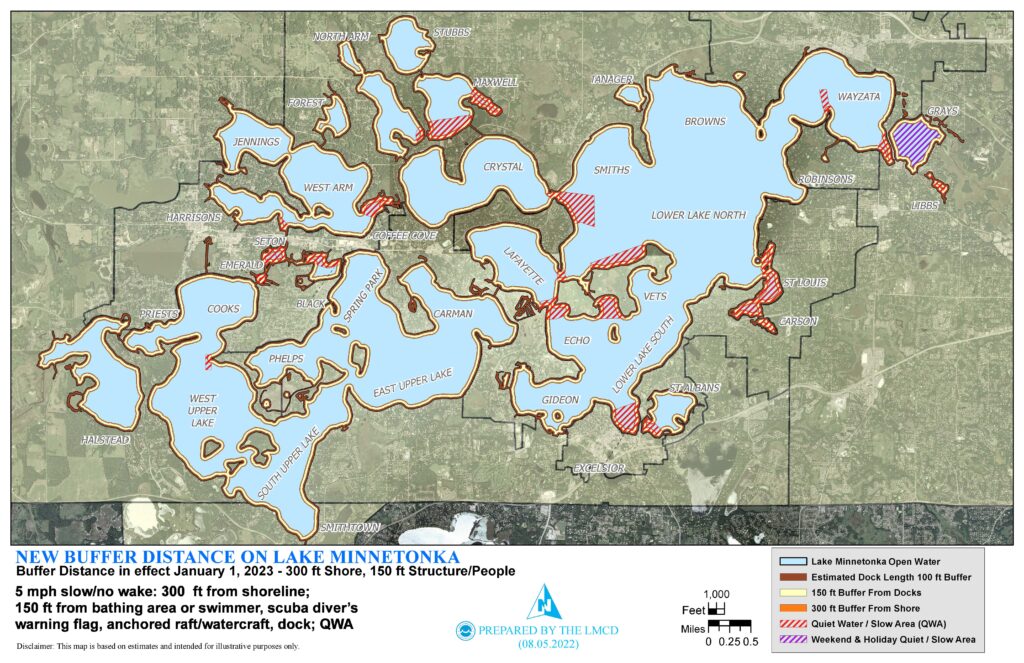
300 FOOT DISTANCE MAP

A file miles per hour speed limit for all watercraft within 300 feet of shoreline and 150 feet of docks, anchored boats, swimmers, and scuba divers’ warning flags is now in effect across Lake Minnetonka. The map below shows the new buffer distance.

New Distance Buffer Map

Frequently Asked Questions About 300 Foot Rule

Many community members voiced concerns about the impact of boat-generated wakes have on their ability to use Lake Minnetonka safely, as well as their negative impact on the lake’s shoreline, private property, and docks. After listening to community members, gathering data, reviewing research, and discussing the issue with member cities and boating industry leaders, we adopted this rule to help preserve Lake Minnetonka and ensure safety for everyone recreating on its waters.

This rule went into effect January 1st, 2023.

This rule applies to all watercraft on Lake Minnetonka, including personal watercraft.

No. This rule does not limit the type of boats on the water – only the speed any boat can travel close to the shoreline.

The 150-foot rule has been in existence for many years. Over time, we have seen a change in the types and sizes of watercraft, in addition to the variety of competing uses on Lake Minnetonka. Combined with the high lake use, we believed the current buffer distance of 150 feet was no longer sufficient for Lake Minnetonka. Therefore, we increased the distance to 300 feet to help preserve the lake and keep it safe and enjoyable for everyone. Since its adoption, we have continued to depend on law enforcement efforts to enforce this rule and help keep everyone safe.

No. When the rule was adopted, we believe that this rule would not hurt the local economy. One of our core objectives as a conservation district is to protect the economy, as well as the environment and vibrancy of Lake Minnetonka.

The buffer distance map shows that the 300 foot rule does not make a bay unusable.

Increasing the distance from 150 feet to 300 feet from anchored rafts or boats could negatively impact some bays if multiple watercrafts are anchored there. Boaters are responsible for their speeds and wakes to ensure other lake users are not harmed by their actions. We also encourage everyone to pay attention to lake conditions and other uses to promote their own safety.

Education is important to us. That is why we have the map available on our website, have posted about the rule on social media, and have included the map in our latest edition of our summer rules brochure.


Own Your Wake Logo

Wake Awareness

Wakes present dangers to lake users and can damage property. Therefore, it is especially important that boaters are aware of their wake and how it impacts shorelines, property, and other people. We are joining the MN DNR’s efforts to bring statewide awareness to and reduce the potential negative impacts of wakes. The following information will help you Own Your Wake and be a responsible boater. Have a safe and fun lake experience.

The Law & Regulations

Damages

Under Minnesota law, the damage your wake causes is treated the same as damage caused by an actual collision. You may also be held accountable for injuries due to your wake.

Slow/No Wake Zones

On Lake Minnetonka, the following Slow/No Wake Zones are established at all times:

  • 300 feet from shore, a dock structure (except towed from), bathing area, swimmer, scuba diver’s flag, anchored watercraft, or other structure
  • 300 feet for a Personal Watercraft (PWC) from shore, a dock structure (except towed from), bathing area, swimmer, scuba diver’s flag, anchored watercraft, or other structure
  • For boats that create large wakes, more distance may be needed. If your wake hits the shoreline, structure, or another watercraft, go farther away or reduce your wake.
  • All Channels
  • Certain Bays: Carsons, Emerald, Libbs Lake, St. Louis, and Grays (4 p.m. Friday through 11:59 p.m. Sunday and all holidays)
  • Partial Bays: Black Lake–north side, Coffee Cove–east of a line from Fagerness Point and Park Lane, Excelsior Bay–south end, Harrisons Bay–north of Seton channel area, Lower Lake North-north side of Big Island/Cruiser’s Cove, Maxwell Bay–south shore from Noerenberg Bridge to Boy Scout Bridge and Noerenberg Inlet, St. Albans Bay–southwest corner, Wayzata Bay–southeast corner near Hwy 101 Causeway

Boating Tips to Reduce Environmental Impacts

Be aware of your environment and what’s going on around you – this applies to everyone on and around the water. The following tips will help reduce environmental impacts.

  • Backing a boat up to lakeshore can damage the area and lead to erosion.
  • Travel slowly or avoid boating in shallow waters. Suspended sediment can reduce water quality such as releasing phosphorus into the water column that can result in algae blooms.
  • High speeds near shorelines lead to large wakes that cause shoreline erosion. It may reduce vegetation needed to stabilize the shoreline or provide habitat for fish or wildlife.
  • Minimize repetitive passes. Once you’ve run a line, move on to another area. A PWC may not be operated more than 30 consecutive minutes in a single area.
  • Comply with all buoys, signs and respect barriers, and any high water declarations and rules in effect.

Please respect the rights of others so everyone can enjoy their time on the water – keep the noise down, be courteous to other boaters, and show consideration to all recreationists on and around the water. Be extra aware of your wake when operating near shore or when water levels are higher than usual.

Additional Resources


Frequently Asked Questions About 300 Foot Rule

Many community members voiced concerns about the impact of boat-generated wakes have on their ability to use Lake Minnetonka safely, as well as their negative impact on the lake’s shoreline, private property, and docks. After listening to community members, gathering data, reviewing research, and discussing the issue with member cities and boating industry leaders, we adopted this rule to help preserve Lake Minnetonka and ensure safety for everyone recreating on its waters.

This rule went into effect January 1st, 2023.

This rule applies to all watercraft on Lake Minnetonka, including personal watercraft.

No. This rule does not limit the type of boats on the water – only the speed any boat can travel close to the shoreline.

The 150-foot rule has been in existence for many years. Over time, we have seen a change in the types and sizes of watercraft, in addition to the variety of competing uses on Lake Minnetonka. Combined with the high lake use, we believed the current buffer distance of 150 feet was no longer sufficient for Lake Minnetonka. Therefore, we increased the distance to 300 feet to help preserve the lake and keep it safe and enjoyable for everyone. Since its adoption, we have continued to depend on law enforcement efforts to enforce this rule and help keep everyone safe.

No. When the rule was adopted, we believe that this rule would not hurt the local economy. One of our core objectives as a conservation district is to protect the economy, as well as the environment and vibrancy of Lake Minnetonka.

The buffer distance map shows that the 300 foot rule does not make a bay unusable.

Increasing the distance from 150 feet to 300 feet from anchored rafts or boats could negatively impact some bays if multiple watercrafts are anchored there. Boaters are responsible for their speeds and wakes to ensure other lake users are not harmed by their actions. We also encourage everyone to pay attention to lake conditions and other uses to promote their own safety.

Education is important to us. That is why we have the map available on our website, have posted about the rule on social media, and have included the map in our latest edition of our summer rules brochure.