
Home Sweet Home On Lake Minnetonka
Is there anything better than living on Lake Minnetonka? Waking up to calm waters out your window, a sun rising on the horizon and a day full of exciting recreational opportunities to enjoy one of Minnesota’s most incredible lakes. Whether you’ve lived on the lake for years or are considering purchasing property, you understand just how important it is to protect and preserve our lake.
The LMCD shares your goals and passion for the lake. We’ve compiled the following information and resources to help answer common questions received about owning lakeshore property. If you have any questions, please feel free to contact us.
Additional Resources
Resources




RESIDENTIAL DOCKS, STRUCTURES, AND WATERCRAFT
DOCKS, DECKS, AND PLATFORMS
Docks, decks, and platforms may exceed 8 feet in length or width, but not both. Ex. 8 ft x 12 ft, but not 9 ft by 12 ft. Docks moved between lakes or waterbodies must be dried out for 21 days to help prevent the spread of aquatic invasive species. Permits are required. Visit the MN DNR website for more information.
LOCATION (AUTHORIZED DOCK USE AREA)
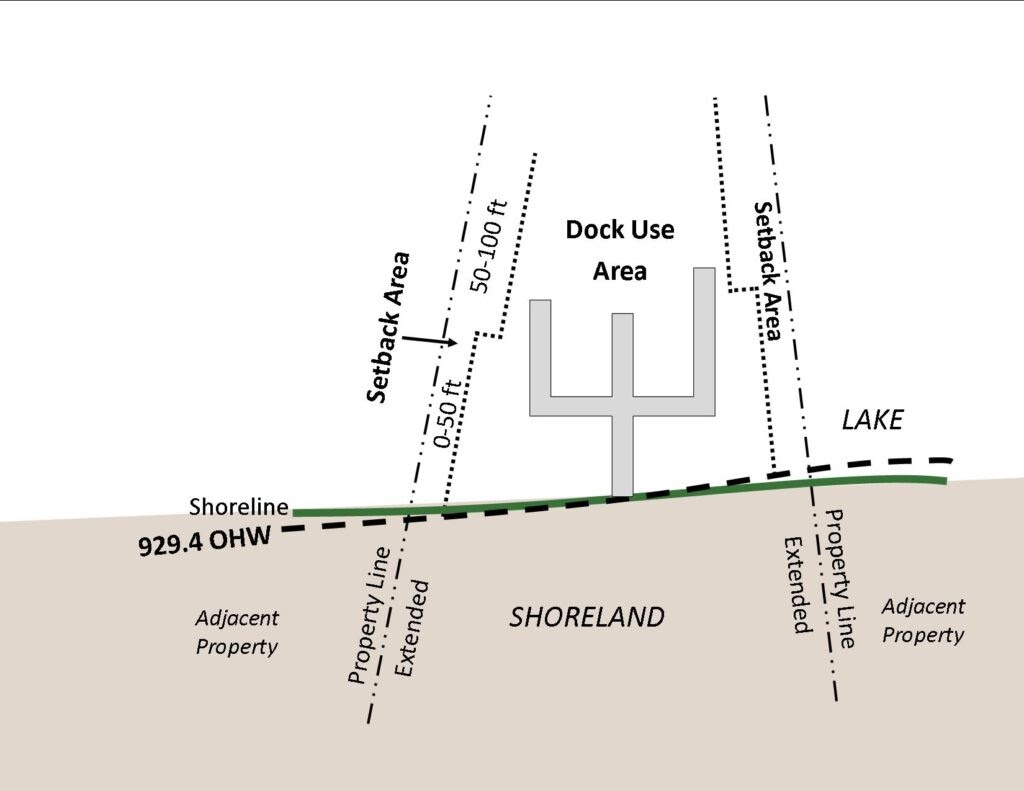
Docks, structures, watercraft and other items must be located within an authorized Dock Use Area, determined by setbacks from the extended side property lines and length into the lake. The Dock Use Area Illustration provides an example of a typical dock use area. A neighboring property owner may allow the dock/watercraft to encroach into the side setbacks under certain conditions. Some uses are allowed if property/site has not been replated, subdivided, combined or otherwise changed since a certain date. Lakeshore characteristics vary; for unusual lots or shoreline, contact the LMCD.
Dock Length
| Shoreline | Feet |
|---|---|
| Equal to shoreline | Up to 100 ft |
| 40 to 60 ft and in existence on 02/05/1970 | 60 ft |
| 40 ft or less and in existence on 02/05/1970 | First reach to 4 ft water depth, max 60 ft |
Setback
| Condition | Feet |
|---|---|
| Dock length 0-50 ft | 10 ft |
| Dock length 50-100 ft | 15 ft |
| Shoreline 50 ft or less; if in existence on 02/05/1970 | 5 ft, if neighbor access not impaired |
| Canopy fabric exceeding 30 inches vertically | 20 ft |
| Slip opens into adjacent property (side opening) | Depth of slip/ min. 20 ft |
WATERCRAFT TYPES & DENSITY
The number of watercraft (called restricted) that can be stored at a property is based on the measurement of the shoreline at the 929.4 OHW. This includes personal watercraft, runabouts, cruisers, pontoons, fishing boats and similar. The following watercraft (unrestricted) are not included in watercraft density calculations if not stored on or above the water such as a lift:
• 16 ft or less in length without a motor
• 16 ft or less with a motor 10 hp or less (manufacturer specs and regardless if operational)
• 20 ft or less without a motor and propelled solely by human power. Ex. Canoe, kayak, paddleboard
WATERCRAFT DENSITY CALCULATIONS
The maximum number of watercraft that can be stored at a property site is
determined as follows, and depends on the site’s characteristics and only if all
other code requirements can be met:
1. 1 watercraft per 50 feet of continuous shoreline regardless of ownership (1:50
ft Rule), or
2. 2 if the site was in existence on 08/30/1978 regardless of ownership (more if
allowed by the 1:50 ft Rule), or
3. Any property may have up to 4 if all the following conditions are met:
i) single family residence, legally subdivided and adjoined to shoreline property,
ii) exclusive dockage use by site’s owner,
iii) all restricted watercraft owned by and registered to persons living on site, and
iv) all applicable code requirements met, or
4. 5 or more by obtaining a license
If you are looking to install a dock at your property, please visit our Business page for contacting a dock installer.
Structures
Lorem ipsum dolor sh2it amet, consectetur adipiscing elit, sed do eiusmod tempor incididunt ut labore et dolore magna aliqua. Ut enim ad minim veniam, quis nostrud exercitation ullamco laboris nisi ut aliquip ex ea commodo consequat. Duis aute irure dolor in reprehenderit in voluptate velit esse cillum dolore eu fugiat nulla pariatur. Excepteur sint occaecat cupidatat non proident, sunt in culpa qui officia deserunt mollit anim id est laborum.
Watercraft Requirements
Lorem ipsum dolor sh2it amet, consectetur adipiscing elit, sed do eiusmod tempor incididunt ut labore et dolore magna aliqua. Ut enim ad minim veniam, quis nostrud exercitation ullamco laboris nisi ut aliquip ex ea commodo consequat. Duis aute irure dolor in reprehenderit in voluptate velit esse cillum dolore eu fugiat nulla pariatur. Excepteur sint occaecat cupidatat non proident, sunt in culpa qui officia deserunt mollit anim id est laborum.
Purchasing Lakeshore Property
Some Items to Consider
The Minnesota Legislature established the LMCD (Minn. Stat. §§ 103B.601-103B.645) more than 50 years ago to help protect the lake, public safety, and the environment. The LMCD’s mission is to preserve and enhance the Lake Minnetonka experience so it continues to be an attractive place to live, do business, and recreate. One of the ways the LMCD carries out its duties is through the development and adoption of regulations and initiatives that apply to uses of the lake.
The characteristic and conditions of the shoreline, water depth, environmental areas, legal encumbrances, and other factors may determine how a property may be used for things like docks, watercraft (types, size, number, etc.), etc. The regulations are somewhat similar to those applicable to on-land storage of vehicles, which can be influenced by the characteristics of streets, landscapes, and driveways. Those new to the lake, or are considering purchasing land on the lake, often have questions about the LMCD and how its regulations affect what can be done on the lake. The following provides information regarding some of the most frequently asked questions to serve as a starting point for those wishing to learn more about how the LMCD regulations affects the use of the lake by adjacent property owners.
Since the lake has so many unique characteristics, please contact the LMCD office for information specific to a particular site. Also, please keep in mind the LMCD cannot recommend whether you should purchase a property and cannot guarantee how its regulations may affect use of the lake in the future. The LMCD can provide information on its current regulations, but any use requiring a permit cannot be decided upon until an application has been processed in accordance with the LMCD Code of Ordinances (“Code”). To aid in the review of a property, a general view and measurement of a property is typically available through the aerials provided on the Hennepin County interactive property map or Carver County interactive property map.
Easements
Generally, for purposes of applying the Code, the riparian rights for the entire site are considered. In cases where those riparian rights are shared among multiple parties for a particular site, the overall site must cumulatively comply with Code requirements. An easement grants the holder a legal right to use another’s land for a specific limited purpose, such as lake access. The legal title to the land remains with the owner of the land. There are a variety of types of easements including, but not limited to, private property easements, conservation easements, public easements, or other types.
If the property you are considering has access to the lake through an easement, be sure to review the language of the easement carefully and consult with your attorney. Easements may provide shared riparian rights that affects the Code allowances such as setbacks and watercraft density. Please refer to our Residential Docks, Structures, and Watercraft handout for setbacks, length, watercraft density, and other requirements.
Common Land
Some entities may have riparian rights for lakeshore properties. For instance, the City of Mound has common land that is dedicated for use as part of their multiple dock program. Other cities may have certain riparian rights to use lakeshore as part of their multiple dock program or for parks or beaches. Homeowner associations may have riparian rights to certain lakeshore or the lakeshore may be dedicated as part of a multiple dock license.
Water Depth
It is important to know the existing water depth in relation to the 929.4 Feet ordinary high water (OHW) level for Lake Minnetonka. The water depths vary significantly in bays and even within the same bay. They also vary depending on the time of year and amount of precipitation. For example, water levels in the fall could be 12 inches below OHW level. Also, if a dock is not used over time, the sediment may accumulate in the location. Therefore, it is important to know the depth or draft of the watercraft intended to be stored at the property as compared to the depth of the water in the area.
Special Lake Characteristics
There are many situations that may affect the use of the lakeshore property. A few to mention include unusual or converging lot lines, lagoons, proximity of channels, or heavy traffic areas.
Variances
The LMCD may have issued one or more variances related to a particular property. A variance is a request to deviate from one or more of the requirements of the Code. Section 6-5.01 of the Code outlines the variance process and requirements. A variance is a limited tool available to address unique situations where the strict application of the Code creates practical difficulties based on conditions unique to the property. The property or neighboring properties may have variances that permanently alter the dock use areas or watercraft allowed.
Lake Friendly Living & Boating
As the largest lake in the Twin Cities and the ninth largest in Minnesota, Lake Minnetonka is one of the state’s most treasured natural resources. With around 4,000 residential and commercial properties on its shores—and countless visitors each year—it’s essential that everyone who enjoys the lake plays a role in protecting its unique character, environmental health, and safety.
Preventing Pollution
Help reduce the risk of pollution on and around Lake Minnetonka by following these best practices:
- Marine Toilets & Sewage Always use proper disposal systems to avoid polluting lake waters. View post.
- Fueling Safety & Fire Prevention Refuel safely and take precautions to prevent spills and fires. View post.
- Dock Structures & Watercraft Storage Make sure your docks, lifts, and stored boats comply with local regulations. View Handout
Lake-Friendly Living Starts at Home
Everyone who lives in or near the Lake Minnetonka watershed, not just shoreline residents—makes daily decisions that impact the lake’s health. The lake is fed by several surrounding watersheds, including Six Mile Creek, Painters Creek, Long Lake Creek, Christmas Lake, Lake Virginia, Langdon Lake, Schutz Lake, Dutch Lake, and Gleason Lake. These, in turn, influence the water quality of the Minnehaha Creek Watershed, which flows downstream from Lake Minnetonka.
Small actions like choosing phosphorus-free lawn treatments, installing permeable pavement driveways, or limiting the use of chemicals near your property’s shoreline or wetland areas, make a big difference.
Lake-friendly living doesn’t mean giving anything up—it means making smart, sustainable choices that benefit both your lifestyle and the lake’s long-term health.
Planning a Project Near the Lake?
Before beginning any shoreline, wetland, or stormwater management project, contact your city or the Minnehaha Creek Watershed District to make sure you have the necessary permits.
Boating Responsibly on Lake Minnetonka
With its size and popularity, Lake Minnetonka is one of the busiest lakes in Minnesota. To keep it safe and enjoyable for all, additional local boating rules are in place—some of which go beyond state law. Be sure to review these resources before heading out on the water:
- Lake Minnetonka Summer Rules Brochure
- Minnesota Boating Guide
- Lake Minnetonka Boating Regulations (LMCD Code)
- Own Your Wake
Stop the Spread of Aquatic Invasive Species (AIS)
Aquatic invasive species pose a major threat to the health of Lake Minnetonka. You can help by taking these simple steps:
- Clean, drain, and dry your boat and any equipment after every use.
- Use only approved bait and dispose of leftovers in the trash.
- Inspect your gear for unusual plants or animals—and report anything suspicious to the Lake Minnetonka Conservation District (LMCD).
Preventing Pollution
View more lake safety tips to promote a safe and fun boating experience.
Permit Applications
Annual permits/licenses are generally not required for single family residential properties.
However, there are some situations where a permit or license is required as listed below:
• License to store five or more watercraft, under certain circumstances allowed by code. Examples include residential properties with or sharing 226 feet or more of 929.4 OHW shoreline, homeowner associations, shared docks, etc.
• Permit for installation of permanent docks, installed using machine driven pilings.
• Permit for dock extension during declared Low Water Conditions
• Nonconforming use permit for docks/moorings in existence since 05/03/1978.
To learn more, visit our Applications and Licenses page for information on our license and permit process and to download applications.
Variances
Lorem ipsum dolor sh2it amet, consectetur adipiscing elit, sed do eiusmod tempor incididunt ut labore et dolore magna aliqua. Ut enim ad minim veniam, quis nostrud exercitation ullamco laboris nisi ut aliquip ex ea commodo consequat. Duis aute irure dolor in reprehenderit in voluptate velit esse cillum dolore eu fugiat nulla pariatur. Excepteur sint occaecat cupidatat non proident, sunt in culpa qui officia deserunt mollit anim id est laborum.
Managing Lake Vegetation
Lorem ipsum dolor sh2it amet, consectetur adipiscing elit, sed do eiusmod tempor incididunt ut labore et dolore magna aliqua. Ut enim ad minim veniam, quis nostrud exercitation ullamco laboris nisi ut aliquip ex ea commodo consequat. Duis aute irure dolor in reprehenderit in voluptate velit esse cillum dolore eu fugiat nulla pariatur. Excepteur sint occaecat cupidatat non proident, sunt in culpa qui officia deserunt mollit anim id est laborum.
Lawn Care & Fertilizer
The chemical treatments and other organic matter on your lawn have the potential to be swept into Lake Minnetonka, whether directly or through storm drainage systems. By being mindful of your lawn treatment decisions, you can eliminate some chemical run-off that degrades the quality of the Lake.
Phosphorus-Free Fertilizers
High levels of phosphorus in a lake increase the severity of algal blooms. When selecting fertilizers for your yard, look for Phosphorus-Free products. In Minnesota, fertilizers containing phosphorus cannot be used on lawns and turf unless the use falls under a small number of exceptions. Learn more about the Phosphorus Lawn Fertilizer Law.
Fertilizer Application
- Follow product instructions. Consult product packaging on how much fertilizer to apply and how often.
- Check the weather. Do not fertilize before a storm.
- Schedule your fertilizer application for maximum effectiveness. For the best results, apply fertilizer in the fall. Do not apply fertilizer to frozen ground.
Other Potential Pollutants
Even natural debris, such as eroded soil, leaves, grass clippings and pet waste, can be a polluting source of phosphorus when it ends up in the water. Be sure to bag or otherwise contain these items to prevent them from being swept away by stormwater.
Shoreline Buffers
Creating a shoreline buffer, aka a vegetative buffer, on your property can protect Lake Minnetonka’s water quality and overall health by:
- stabilizing soil and reducing erosion
- filtering out pollutants and sediments
- absorbing nutrients from storm water
- offering shelter for local wildlife
Help Lake Minnetonka and help yourself.
Adding a shoreline buffer of native vegetation can save you time and money on maintenance, as well as provide added privacy from lake users. Visit the MN DNR website or MinnehahaCreek.org for information about recommended plants and how to get started.
Water Gardens & Aquariums
A water garden or pond can be a beautiful addition to a backyard, but extra precautions should be taken when designing and adding vegetation to a water feature so close to a natural body of water.
Key Considerations
- Design you water garden so that it will not flood and release vegetation and animals into nearby public waters during a heavy rain event. Find more design information HERE.
- Choose vegetation species that are either native to your area or are not considered invasive. For information on aquatic plants native to Minnesota, visit the MN DNR website.
For tips on installation and establishing plants, visit the UMN Extension website.
Unwanted Plants and Pets
If circumstances change and you no longer are able to keep the fish or aquatic plants from your aquarium or pond, do not release them into the wild. Seal aquatic plants in a plastic bag and dispose of them in the trash. Find your pet a new home.
Permeable Pavements
When water lands on an impermeable surface, it runs off, collecting pollution (trash, sediments, nutrients, etc.) as it goes. The more impermeable surface area there is in a given area, the more storm water run-off there will be flowing into nearby waterways. When water lands on a permeable surface, it soaks in and the larger particles can be filtered out before the water meets up with nearby water bodies.
Reduce the Amount of Impermeable Surface on Your Property
The best way to reduce the amount of storm water run off is to reduce the amount of impermeable surfaces. You can do this by keeping paved driveways and pathways as small as possible or, better yet, by using permeable alternatives.
For more information on appropriate applications and maintenance, visit the MN DNR website.